Why Australian Artists Are Finally Ditching the Lone Wolf Studio Model — and Looking to NZ to Learn How
There's a particular kind of loneliness that comes with the Australian studio experience. You know the one — a rented room, a door that stays shut most of the week, and a creative practice that exists largely in isolation from the people around you. It's been normalised for so long that most artists here haven't stopped to question it. But a growing number of Australian creatives are doing exactly that, and they're finding their answers across the Tasman.
New Zealand has, for decades, cultivated a way of working that treats collaboration not as a nice-to-have but as the actual engine of creative output. It's not just about sharing a building. It's about something more intentional — a culture of creative interdependence that's baked into how NZ artists form relationships, share resources, and hold each other accountable to the work.
The Collective Isn't a Trend — It's Infrastructure
In Wellington, collectives like Toi Pōneke have been running artist studios and residency programmes for years, not as a bohemian experiment but as a serious cultural infrastructure investment. Artists working within these frameworks don't just share space — they share knowledge, critique, opportunity, and often, audience.
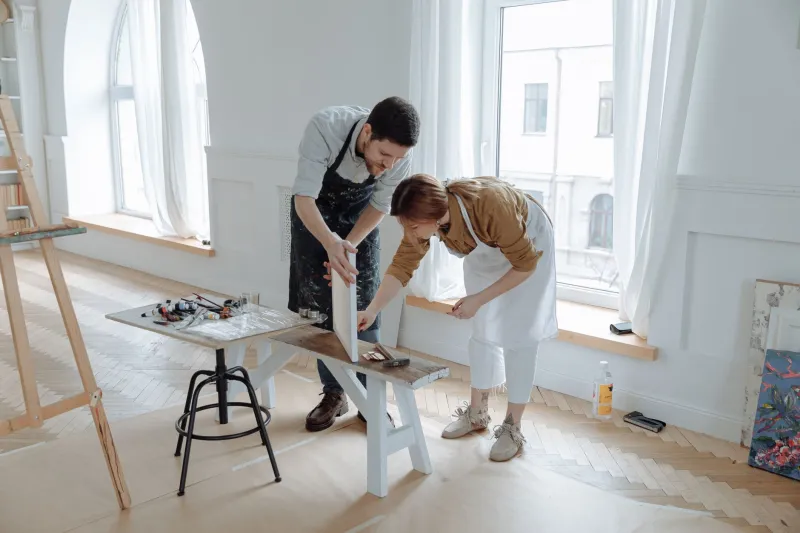
Auckland tells a similar story. Shared studio communities across Tāmaki Makaurau have produced some of the country's most internationally recognised work, partly because the model creates a kind of creative friction that solo practice simply can't replicate. When a painter is working three metres away from a sound artist and a textile designer, things bleed into each other. Ideas mutate. Work gets challenged before it gets comfortable.
This isn't accidental. There's a philosophical underpinning to it — one that draws, at least in part, from te ao Māori values around community, reciprocity, and the idea that creative expression is rarely, if ever, a solitary act. The concept of whanaungatanga — building meaningful relationships through shared experience — has shaped how many NZ creatives understand what a studio community is actually for.
What Australian Artists Are Noticing
Melbourne-based multidisciplinary artist Priya Sundaram spent three months in Wellington through a residency exchange in 2023. She came back with more than new work.
"I'd been operating in this very self-contained way for years," she says. "My practice was mine, my process was mine, my studio time was mine. And then I walked into this Wellington collective and realised everyone there was treating their work like it belonged to the room somehow. Not in a precious way — in a generative way."
The shift she's describing isn't about losing creative ownership. It's about understanding that isolation, while it can produce depth, often does so at the cost of relevance. Work made in a vacuum can feel like it too.
Sydney-based ceramicist and educator Dan Kowalski has been running workshops for the past two years that draw explicitly on what he observed during a stint in Auckland's shared studio scene. "The thing that struck me was how fast everyone moved," he says. "Not in a sloppy way — in a confident way. Because they were getting constant feedback. They weren't waiting until a piece was finished to find out if it was working."
Kowalski now structures his own practice around a small collective of five artists in Marrickville, with monthly open crits and a shared materials budget. He credits the model directly to what he observed in Auckland. "It felt almost obvious once I'd seen it. Why had I been working alone for so long?"
The Speed and Quality Argument
One of the less-discussed benefits of the NZ collective model is how dramatically it can accelerate a creative practice. When you're embedded in a community of makers, you're not just getting feedback — you're absorbing influences, techniques, and approaches through proximity. You pick things up without even trying.
This has real implications for the quality and cultural currency of the work being produced. Australian galleries and commissioning bodies are increasingly noting that work coming out of NZ collective environments tends to feel more assured, more contextually grounded, and more connected to contemporary conversations — even when the individual artist is relatively early in their career.
That's not a coincidence. It's what happens when creative development is treated as a communal project rather than a private one.
The Barriers Are Real, But They're Shifting
None of this is to suggest that Australian artists are simply resistant to collaboration — the barriers here are structural as much as cultural. Studio rents in Sydney and Melbourne are punishing. The gig economy has pushed many creatives into fractured, hustle-driven schedules that don't leave much room for the slow relationship-building that genuine collective practice requires.
But things are shifting. Co-working models adapted from the tech sector have started appearing in creative precincts across Brisbane, Adelaide, and Perth. And a handful of Australian arts organisations — inspired in part by what they've seen coming out of NZ — are experimenting with funding models that support collective applications rather than just individual ones.
Arts funding bodies in particular are beginning to ask different questions. Not just "what will you make?" but "who will you make it with, and what does that relationship look like?"
Connection as Creative Method
What the NZ model ultimately offers isn't a template — it's a reframe. The question it poses to Australian artists is a simple but disruptive one: what would your practice look like if connection was the method, not just the outcome?
For a lot of Kiwi artists, that question has already been answered through decades of lived creative culture. The collectives, the shared studios, the open-door critique sessions — these aren't extras bolted onto a solo practice. They're the practice.
Australia has its own rich traditions of community-making and creative solidarity. The challenge isn't importing a foreign model wholesale — it's recognising what's already here, and giving it the structural support it needs to flourish.
The NZ creative community didn't arrive at its collaborative culture overnight. It was built through deliberate investment — in spaces, in relationships, in the belief that art made together carries something that art made alone rarely can.
That's worth paying attention to. And increasingly, Australian artists are.